VietNat
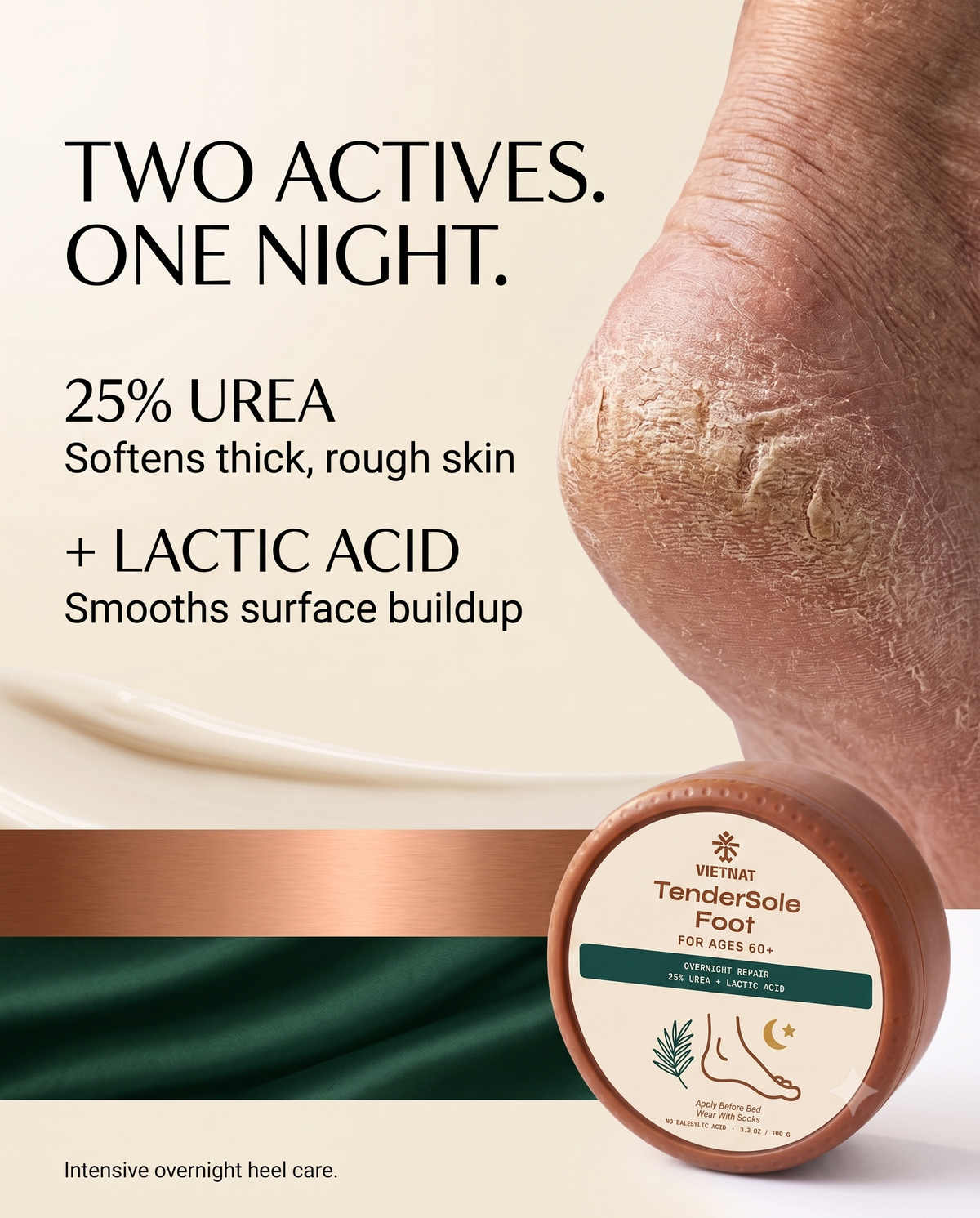
VIETNAT TenderSole Overnight Repair Balm for Ages 60+| For heavily dry and cracked-looking heels with Urea + Lactic Acid + Shea Butter + Vietnamese Coconut Oil| 3.5 OZ / 100 G
VIETNAT TenderSole Overnight Repair Balm for Ages 60+| For heavily dry and cracked-looking heels with Urea + Lactic Acid + Shea Butter + Vietnamese Coconut Oil| 3.5 OZ / 100 G
Couldn't load pickup availability
VIETNAT TenderSole · For ages 60+
Apply before bed. Wear with socks.
The Overnight Repair Balm is the stronger half of the TenderSole routine — for heels that are heavily dry and cracked-looking, where a daytime cream has not been enough on its own.
It runs two keratolytic actives rather than one: 25% urea and 5% lactic acid. Two different mechanisms, which is what the clinical literature recommends once skin has genuinely thickened — not simply more of a single ingredient.
Around them, a thick occlusive base: shea butter, Vietnamese coconut oil and rice bran oil, to hold everything against the skin for seven or eight uninterrupted hours.
Still no salicylic acid, and still a cosmetic balm rather than a drug. Thick on purpose, because you are going to sleep, not going out.
The work happens while you sleep.
Why a night balm at all
Eight hours of contact is the ingredient nobody lists.
A cream you put on in the morning has minutes before a sock, a shoe and your own body weight go to work on it. The same actives, applied at night under a cotton sock, stay in contact with the skin for seven or eight hours instead. For skin that has genuinely thickened, that difference in contact time matters as much as the strength on the label.
Which is why this one is thick, and unapologetically so. It is not trying to disappear in thirty seconds. It is trying to still be there at six in the morning.
The other half is the pairing of actives. Urea breaks the hydrogen bonds in hardened surface skin so it can hold water again; lactic acid loosens the bonds between the surface cells themselves. Two routes to the same result, which is the approach the literature favours for heels well past ordinary dryness.
The gap this fills
Night balms moisturise. They do not soften.
Look at what is actually sold as an overnight foot treatment and you find a consistent pattern: petrolatum, glycerin, shea or cocoa butter. Good occlusives, all of them — and not one keratolytic active among them. They seal moisture in, which is genuinely useful, but they do nothing to the hardened layer that made the heel rough in the first place.
Meanwhile the products that do carry real urea sit in ordinary daytime tubes, formulated to absorb fast and get out of the way — the opposite of what an overnight product should do.
This balm is the combination that was missing: keratolytic actives at meaningful strength, in a base heavy enough to earn a night under a sock.
Which one do you need
Daily cream, night balm, or both.
Daily Repair Cream · 20% urea
Dry and rough, but manageable
Flaking, catches on a bedsheet, no real hard pad. A light cream twice a day handles it, and you can put shoes on straight after.
This balm · 25% urea + 5% lactic acid
Thickened, with lines you can see
A hard pad across the heel, visible dry lines, sometimes tender by the end of the day. Two actives and a night under socks.
See a doctor first
Deep splits, bleeding, or infection
Beyond what a cosmetic balm should be asked to do. If you have diabetes, speak to your doctor before treating any foot skin problem.
Plenty of people use both: the cream in the morning so feet are comfortable in shoes, the balm at night for the deeper work. They are built to sit next to each other.
What is in it
Two actives to soften, three oils to hold.
The actives do the work on hardened skin. The oils are what keep them there all night instead of on your bedsheet.
Active one · 25%
Urea
Humectant and keratolytic
Breaks the hydrogen bonds in hardened surface skin so it holds water again. Five points stronger than the daytime cream, because an overnight product does not need to absorb in a hurry.
Active two · 5%
Lactic Acid
Alpha hydroxy acid
Works on the bonds between surface cells — a different route from urea. Pairing two mechanisms is what the literature recommends for heels well past ordinary dryness.
The occlusive base
Shea Butter
Butyrospermum parkii · 8–10%
What makes this a balm rather than a cream. It sets a thick seal over the actives so they are still working hours later.
Vietnamese ingredients
Coconut + Rice Bran Oil
Cocos nucifera · Oryza sativa bran
The same two oils as the daytime cream, at higher levels here. Coconut seals; rice bran brings vitamin E, pressed from the bran left over from milling rice.
Glycerin, panthenol and allantoin round it out. No salicylic acid, no synthetic fragrance, no menthol — the faint warm scent is the coconut oil, and nothing has been added to be smelled.

Compared with the category
How it differs from an overnight foot balm.
| TenderSole Overnight Balm | Typical night balm or stick | |
|---|---|---|
| Keratolytic actives | Urea 25% + lactic acid 5% | None — occlusives only |
| Occlusive base | Shea butter + Vietnamese coconut and rice bran oil | Petrolatum, glycerin or cocoa butter |
| Salicylic acid | None — cosmetic, not a drug | Common in the strongest heel formulas |
| The routine | Printed on the front: apply before bed, wear with socks | Rarely specified at all |
| The jar | Wide mouth, ridged screw lid, opens one-handed | Roll-on stick or standard tube |
| Who it says it is for | Ages 60+, on the front of the jar | Everyone, at every age |
Comparison drawn from our own category review, August 2026. It describes the category, not one named competitor.
How to use
Three steps, the last one before you get into bed.
01
Wash and dry your feet
Clean, and properly dry between the toes. Two minutes, sitting on the edge of the bed.
02
A thick layer on the heel
More than you would use in the morning. Do not rub it in until it disappears — you want it sitting on the skin.
03
Thin cotton socks, then bed
The socks are not optional. They keep the balm on the heel instead of on the sheet, and they are what makes eight hours of contact possible.


The jar
A jar, because a balm this thick will not come out of a tube.
Wide mouth, shallow bowl
Take what you need with two fingers, and see how much is left. No squeezing a stiff balm through a narrow nozzle.
Ridged lid, opens one-handed
The rim is ridged the whole way round for grip, and there is no child-resistant mechanism to fight in a dim bedroom.
100 G, and it lasts
Two heels, once a night. Most people get two to three months from a jar, which makes it the cheaper half of the routine per night.

If you are buying it for yourself
It lives on the bedside table with the reading glasses, not in the bathroom cabinet. Two minutes before the lamp goes off, and the socks do the rest.
If you are buying it for a parent
Heels are hard to reach and easy to ignore. The routine is printed on the front of the jar in three short lines, which makes it easy to explain once and then leave alone.
Key benefits
- Urea 25% + lactic acid 5% — two mechanisms
- Shea butter, coconut and rice bran oil
- Built for overnight contact under socks
- No salicylic acid, no synthetic fragrance
- Made for ages 60+, said on the front
- Wide jar, ridged lid, opens one-handed
- Pairs with the TenderSole Daily Repair Cream
Ingredients (INCI)
Aqua (Water), Urea (25%), Butyrospermum Parkii (Shea) Butter, Lactic Acid (5%), Cetearyl Alcohol, Glyceryl Stearate, Cocos Nucifera (Coconut) Oil (Vietnamese), Glycerin, Oryza Sativa (Rice) Bran Oil (Vietnamese), Panthenol, Allantoin, Phenoxyethanol + Ethylhexylglycerin, Citric Acid.
No salicylic acid, no added synthetic fragrance, no menthol, no parabens, no formaldehyde-releasing preservatives.
For external use only. For use on heels and feet. Do not apply to broken, split or bleeding skin. Avoid contact with eyes and rinse thoroughly if contact occurs. A patch test is recommended before first use. Discontinue use if irritation occurs. Keep out of reach of children. If you have diabetes, consult a doctor before treating any foot skin condition. Not intended to diagnose, treat, cure, or prevent any disease.
Questions
Answers, in plain terms.
Do I need this as well as the daily cream?
Not necessarily. If your heels are dry and rough but not hard, the 20% cream on its own is enough. This is for heels that have genuinely thickened, and many people use both — cream in the morning, balm at night.
Do I really have to wear socks?
For this one, yes. It is thick by design and will transfer to your bedding without them. Thin cotton is ideal — nothing special needed.
Why urea and lactic acid together?
They work by different mechanisms — urea on water-holding in the outer layer, lactic acid on the bonds between surface cells. Pairing two is what the literature recommends for heels well past ordinary dryness, rather than pushing one ingredient higher and higher.
Will it sting?
On intact, thickened skin most people feel nothing, though there can be brief warmth from the lactic acid. Do not use it on split or open skin — that needs a doctor, not a balm. Patch test first.
Does it remove calluses?
We will not say that, because callus and corn removal is a regulated drug claim with its own labelling rules. What this balm does is smooth and soften rough, thickened, dry skin overnight.
I have diabetes. Can I use it?
Ask your doctor before you treat any foot skin problem. Feet need closer attention with diabetes, and that advice should come from someone who knows your case rather than from a product page.
Can I use it in the morning instead?
You can, but it is not designed for it. It is thick and slow, and it will mark your socks. Use the Daily Repair Cream for daytime.
How long before I notice a difference?
The heel usually feels softer after the first few nights. Real change in a thickened heel takes several weeks of not skipping nights, which is exactly why the routine is kept to three short steps.
Does it smell of anything?
Faintly of coconut, from the oil itself. There is no added fragrance and nothing to mask a smell.
How long does one jar last?
3.5 OZ / 100 G. Used on both heels once a night, most people get two to three months from it.