VietNat
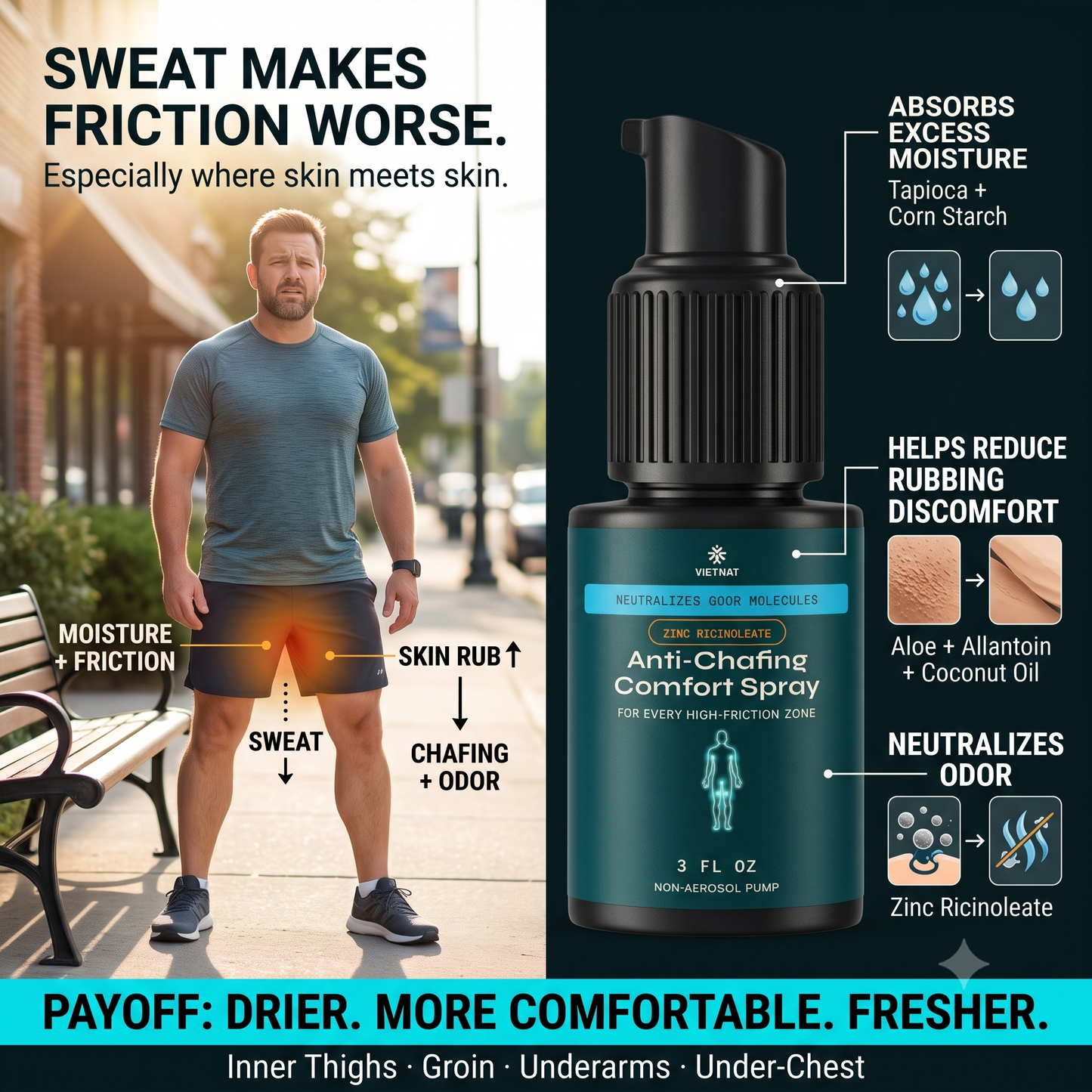
VIETNAT Anti-Chafing and Odor Comfort Spray | For Groin, Thighs, Underarms & Under-Chest | Neutralizes Odor Molecules with Zinc Ricinoleate + Vietnamese Cajuput | Talc-Free Non-Aerosol Powder Spray, 3 FL OZ
VIETNAT Anti-Chafing and Odor Comfort Spray | For Groin, Thighs, Underarms & Under-Chest | Neutralizes Odor Molecules with Zinc Ricinoleate + Vietnamese Cajuput | Talc-Free Non-Aerosol Powder Spray, 3 FL OZ
Couldn't load pickup availability
VIETNAT · For every high-friction zone
Absorbs sweat. Neutralizes odor. Not just one or the other.
A talc-free powder spray for the places where skin meets skin or fabric all day — groin, inner thighs, underarms, under the chest, feet.
Every product in this category absorbs moisture. Ours does that too, with tapioca and corn starch. The difference is what happens to the smell: zinc ricinoleate binds odor molecules rather than covering them with fragrance, and Vietnamese cajuput works on the bacteria that produce them in the first place.
Non-aerosol pump, so nothing is propelled into the air you are breathing in a small bathroom. Talc-free. Allantoin and aloe to settle skin that has already been rubbed.
Dry is half the problem. This handles both halves.
What the category gets half right
Staying dry does not make the smell go away.
Almost every anti-chafing powder works the same way: starch absorbs moisture, which reduces friction and slows the bacteria down. That part is genuinely useful, and we kept it — tapioca and corn starch, the mechanism the best-selling products in this category have proven.
But odor is not moisture. It comes from specific volatile molecules produced when skin bacteria break down sweat, and drying the area only slows that down. Most sprays deal with the remainder by adding fragrance on top, which is covering, not removing.
Zinc ricinoleate does something different. Derived from castor oil and in commercial use for over seventy years, it binds odor molecules through ion complexation — the molecule is held rather than masked. Cajuput, distilled in Vietnam from Melaleuca cajuputi, works one step earlier, on the bacterial load itself.
Where it goes
Anywhere skin meets skin, or skin meets fabric.
The two best-known products in this category are named after one body part, which tells you who they think is buying. Chafing is not that narrow: it happens to runners, to anyone carrying extra weight, in a heatwave, on a long flight, under a bra strap, in a uniform.
01
Groin
Warm, covered, and in motion all day. The reason this category exists.
02
Inner thighs
Skin against skin with every step. Shorts, a hot day, a long walk.
03
Underarms
Use it on a day when a stick deodorant is not enough on its own.
04
Under the chest
Under a band or a strap, where sweat sits and has nowhere to go.
Feet and inside socks work too. Avoid broken skin and mucous membranes.

What is in it
Two mechanisms for dryness, two for odor.
The starches keep the area dry, which is what reduces friction. The other two actives are the ones the rest of this category leaves out.
For dryness
Tapioca + Corn Starch
Talc-free absorbents
Take up moisture so skin glides instead of dragging. Plain physics, and the mechanism the leading products in this category are built on.
For odor · what others skip
Zinc Ricinoleate
From castor oil
Binds odor molecules by ion complexation rather than masking them with fragrance. In commercial use for over seventy years.
For odor · what others skip
Vietnamese Cajuput
Melaleuca cajuputi leaf oil
Distilled in Vietnam, where it has been a household remedy for generations. It works on the bacteria that produce odor, one step before the smell exists.
For comfort
Allantoin, Aloe + Coconut Oil
Soothing and slip
Allantoin and aloe settle skin that has already been rubbed. A small amount of coconut oil reduces the friction itself rather than only the moisture.


Compared with the category
How it differs from a comfort powder spray.
| VIETNAT | Typical anti-chafing spray | |
|---|---|---|
| Keeps you dry | Tapioca + corn starch | Starch, usually the same |
| Neutralizes odor molecules | Yes — zinc ricinoleate | No — fragrance covers instead |
| Works on odor bacteria | Yes — Vietnamese cajuput | Not usually addressed |
| Where it is for | Four zones, named on the bottle | Often one body part, in the brand name |
| Format | Non-aerosol pump, talc-free | Aerosol, cream, or powder spray |
| How it reads on a shelf | Plain and unembarrassing | Frequently a joke about anatomy |
Comparison drawn from our own category review, August 2026. It describes the category, not one named competitor.
How to use
Clean, dry skin. Two or three pumps. Done.
01
Start dry
After a shower, or before you get dressed. A powder spray on damp skin clumps rather than spreads.
02
Two or three pumps per zone
Hold about a hand's width away. The pump is targeted, so nothing drifts across the bathroom.
03
Get dressed straight away
It dries to a light powder finish immediately. Reapply after a workout or in the middle of a hot day.

If you sweat and chafe
Two or three pumps before you get dressed, and again after the gym. Nothing on the bottle is a joke about your body, and nothing in it is trying to perfume you.
If you are past sixty
Age-related odor and friction often arrive together, and this spray handles the second one without a scent that fights your other products. It sits alongside our TeaLeaf range rather than replacing it.
Key benefits
- Neutralizes odor molecules — zinc ricinoleate
- Works on odor-causing bacteria — Vietnamese cajuput
- Absorbs sweat with tapioca and corn starch
- Four zones: groin, thighs, underarms, under-chest
- Talc-free and non-aerosol
- Allantoin and aloe for rubbed skin
- No fragrance doing the work
Ingredients (INCI)
Aqua (Water), Tapioca Starch, Zea Mays (Corn) Starch, Zinc Ricinoleate, Melaleuca Cajuputi Leaf Oil (Vietnamese cajuput), Aloe Barbadensis Leaf Juice, Allantoin, Cocos Nucifera (Coconut) Oil, Caprylyl Glycol, Phenoxyethanol + Ethylhexylglycerin, Citric Acid.
Talc-free, aluminium-free, no aerosol propellant, no parabens.
For external use only. Do not apply to broken or irritated skin, and avoid mucous membranes. Do not inhale. Avoid contact with eyes and rinse thoroughly if contact occurs. A patch test is recommended before first use. Discontinue use if irritation occurs. Keep out of reach of children. This is a cosmetic product, not a treatment for any fungal or bacterial infection. If itching, redness or a rash persists, see a doctor. Not intended to diagnose, treat, cure, or prevent any disease.
Questions
Answers, in plain terms.
How is this different from the powder sprays already out there?
They absorb moisture; so does this. The difference is the two odor actives. Zinc ricinoleate binds odor molecules instead of masking them, and cajuput works on the bacteria that make them. Most products in this category rely on fragrance for that part.
Is it just for men?
No. Chafing happens under a bra band, between thighs in a heatwave, in a uniform, on a long run. The bottle names four zones rather than one body part on purpose.
Will it treat jock itch or a fungal infection?
No, and we will not suggest otherwise. This is a cosmetic comfort spray. Persistent itching, redness or a rash needs a doctor, and possibly an antifungal medicine — which this is not.
Does it replace my deodorant?
It can be used on underarms, but it is not an antiperspirant and does not affect sweating. Most people keep their usual deodorant and use this for the areas it does not cover.
Does it have a strong scent?
There is a faint clean note from the cajuput oil itself, and it fades. Nothing has been added to perfume you, because the point is to remove odor rather than layer something over it.
Why a pump instead of an aerosol?
A pump puts the powder where you aim it rather than into the air of a small bathroom, there is no propellant, and it travels without pressurised-can restrictions.
Will it mark my clothes?
It dries to a very light powder finish. Let it settle for a few seconds before dressing, as you would with any powder.
Is there talc in it?
No. The absorbents are tapioca and corn starch. There is no talc and no aluminium.
How long does one bottle last?
3 FL OZ. At two or three pumps across a couple of zones daily, most people get about six to eight weeks from it.